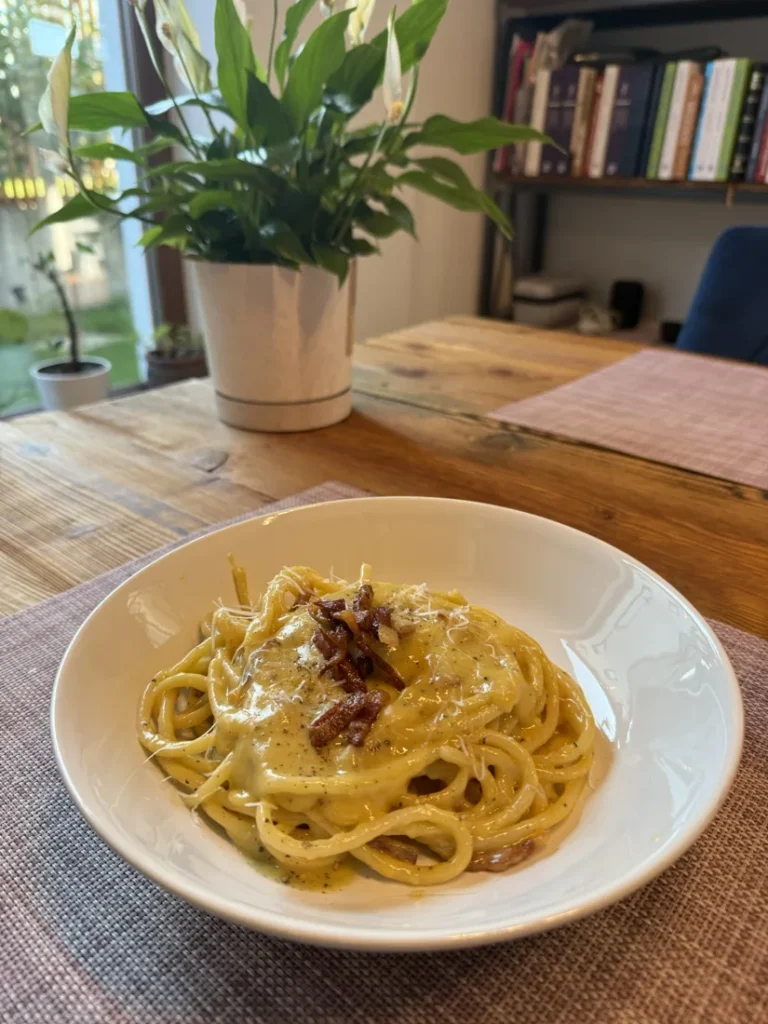
Cut the guanciale into thin strips or batons, whichever you prefer.
Put it into a cold pan and start heating slowly over low heat. The fat should gently render as the guanciale becomes golden and crisp.
Once ready, set about one third of the guanciale aside for finishing the dish. Leave the fat in the pan.
Cook the pasta in salted water. Go easy on the salt: both guanciale and Pecorino Romano are salty.
Do not discard the pasta cooking water.
Combine the egg yolks and whole egg in a bowl.
Add finely grated Pecorino Romano, plenty of freshly ground pepper and a little rendered guanciale fat.
Mix thoroughly into a thick, uniform paste.
Add 1–2 tablespoons of hot pasta water and mix again. The mixture should become creamy but remain fairly thick.
Transfer the pasta, cooked very al dente, directly to the pan with the guanciale fat.
Add a little pasta water and toss or stir vigorously so that the fat combines with the starch.
Add freshly ground black pepper.
Remove the pan from the heat and let it cool slightly for several seconds.
Add the egg-and-cheese mixture and about two thirds of the guanciale.
Toss or stir vigorously until a smooth, glossy emulsion forms.
If the sauce is too thick, add pasta water a little at a time.
If it is too thin, keep tossing briefly off the heat. Do not put the pan straight back onto a hot burner; the eggs can scramble very easily.
Serving
Transfer the pasta to plates.
Top with the remaining guanciale, some Pecorino Romano and freshly ground black pepper.
Serve immediately.
Texture is everything: carbonara should be creamy, glossy and cling closely to the pasta. The sauce must neither scramble nor run off the pasta.
About the pasta
For carbonara, as for gricia, I mainly use pici toscani. Good bigoli also work well.
The pasta needs to be thick and rough-textured, made from good semolina and with a long cooking time. In such a simple sauce, pasta quality really does make a difference.